The drive south was marked not so much by miles traveled, but by degrees of temperature rising. The smallest variation raised the mood. "Look, it has gone up from 28 degrees to 29 degrees! WOOHOO!!!" Lower temperatures were quickly excused. "It's just because we are in this higher elevation. It'll warm up as we go downhill."
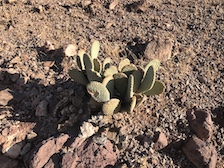
Suddenly, (remember, everything seems exciting when you are going TOWARD vacation) a small prickly pear cactus was spotted by the roadside. Oh the rejoicing! But, as I checked my phone to find out about how prickly pears are clearly a sign that you are in the south, it turns out that prickly pears grow just about anywhere they can find a little sand or gravel and some sun. Some varieties can survive -30F temperatures. As an aside, they can be used as a vegetable, and their fruits can be used in jellies and sauces. Many grocery stores carry them. I made a mental note to cook something with prickly pear in it when I returned home.
Knowing that Joshua trees only grow only at certain elevations in the southwest, I was on high alert for the first one. I shouted and pointed when I saw one, much like an old lady at a Bingo hall. These trees grow in California, Arizona, Nevada, and Utah at elevations roughly between 1300 - 6000 feet above sea level. They look like a tree crossed with a sheepdog but aren't descended from either.
Originally scientists catalogued the Joshua tree in the lily family (Liliaceae). Since then, after DNA studies, they have been reclassified as part of the...asparagus family (Asparaguceae). Just what I would've guessed. Or not. I learned this on the National Parks website, which is how you know it’s true, because the government would not joke about asparagus.
And speaking of National Parks, one of our hostesses took us to the Joshua Tree National Park. Absolutely stunning. The landscape is all smooth, massive rock formations with many, many shaggy Joshua trees standing around cheering.
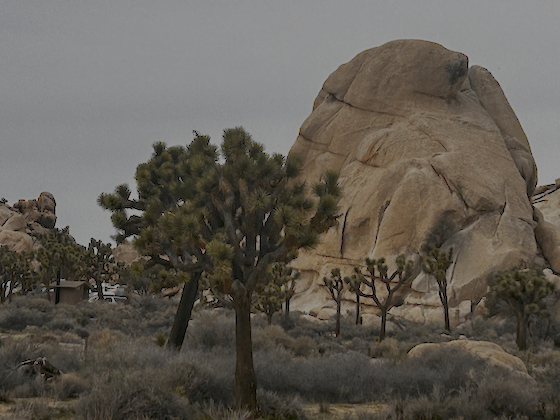
We admired the scenery and climbed on the rocks, being inspired by childhood memories of this sort of thing. Except my childhood memories of climbing up and down big rocks, yea, even leaping from rock to rock, were in sharp contrast to the reality I was feeling. Climbing up isn't too difficult. Climbing down is difficult. And scary. Leaping is out of the question.
Still, it was a wonderful afternoon of beautiful scenery, fresh air, and just enough adrenaline to add interest. Happily, all three of us made it out alive without requiring a helicopter rescue—a major athletic achievement.
And then came the grand finale of our golf trip: being up close to giant Saguaro cactuses. Or cacti if you prefer. (It sounds more scientific, but won't get you invited to more dinner parties if you get all dogmatic about it.)
Yes, our golf is that bad.
We hiked for about two miles through an area near the Saguaro National Park. The cacti stood tall across the landscape, seeming to wave in friendly greeting to us. Except their arms weren't moving. It's more of a ‘salutation arm raise’ which matches their stately, sculpted appearance.
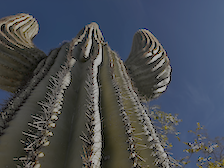
Saguaro Cactus are protected. And no wonder. A ten year old cactus might reach a towering 1.5 inches tall. Yes, inches. After about 10 years, they step up the pace to one or two feet annually. After 50 to 70 years, they start to grow those saluting arms if conditions are right. Favorable conditions cause them to grow faster. They reach their full height (10 - 40 feet tall) after 150 - 200 years. They store water which makes them heavy. Very heavy. They can weigh 2 - 3 tons. That is more than my car weighs. And speaking of my car, our travel time was running out. It was time to leave the desert and its elegant adaptations.
For some reason, the return trip from any escape takes ten times longer than the trip out—even if you stop for absolutely nothing and drive like you’re being chased. Even though you are excited to get back to the familiar.
Still, I’m grateful for this desert adventure. The desert may look empty, but is actually full of beautiful design. A design shaped by wisdom that creates beauty not in spite of harsh places, but specifically for them.